
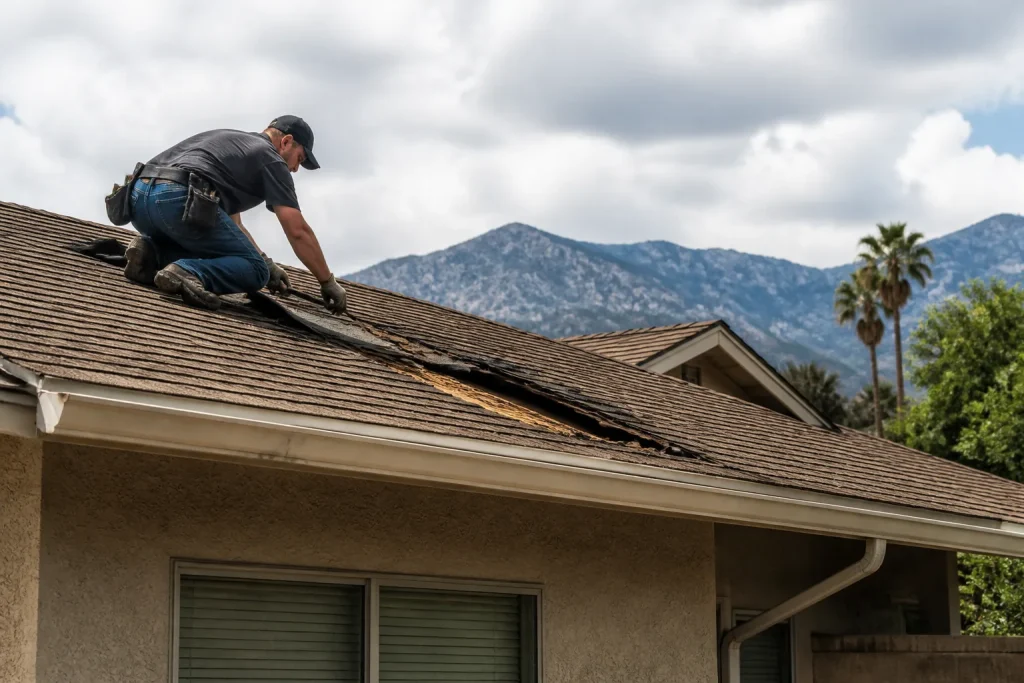
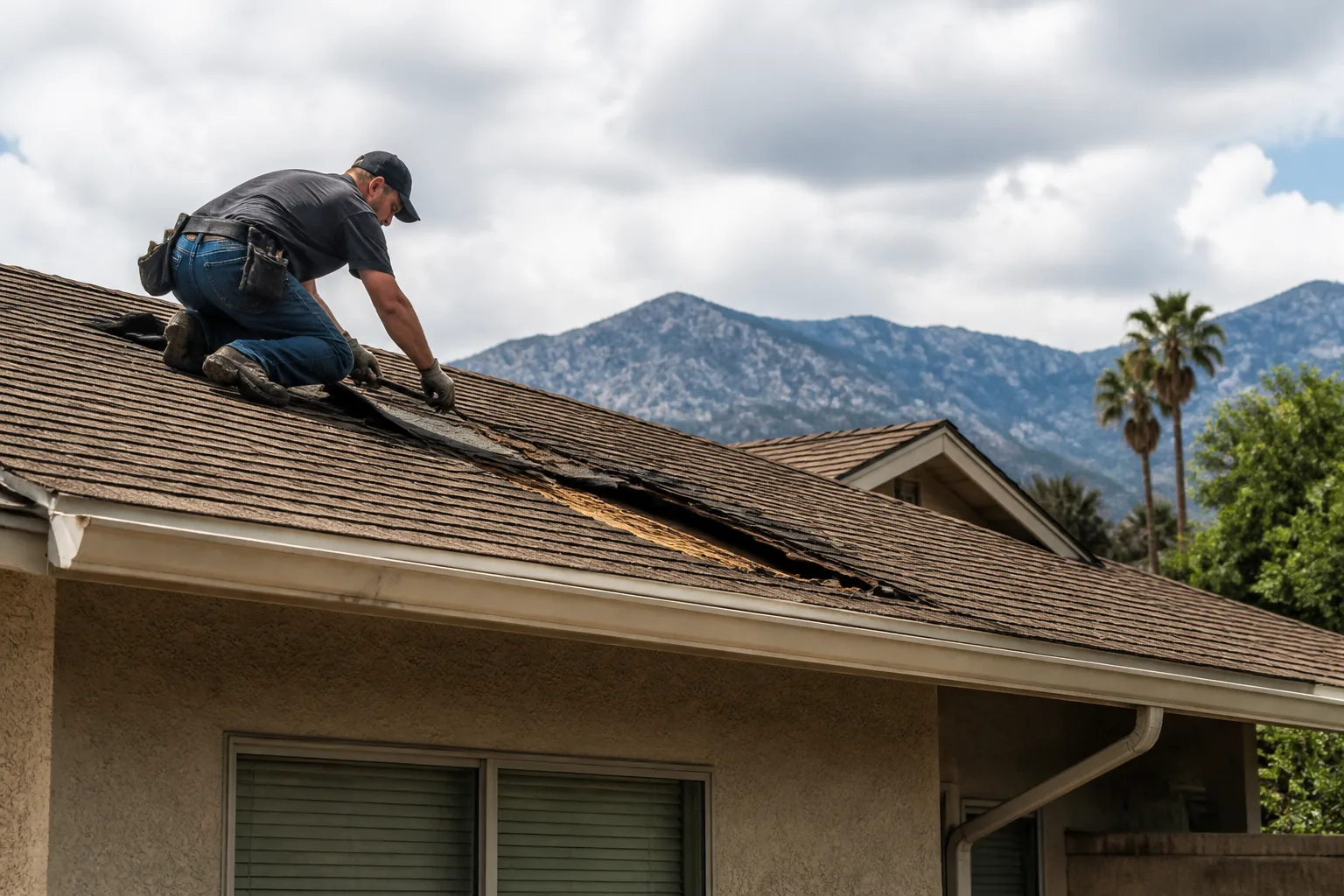
Emergency Roof Repair Near Me: What Rancho Cucamonga Homeowners Should Do First
When water is coming through your ceiling in Rancho Cucamonga, the first thing to do is contain the water inside the house, then document everything with photos, then call your insurance company. The contractor call comes after those three steps. We know that sounds backwards after years of “call a roofer first” advice, but getting the sequence right in the first 90 minutes determines how much of your repair bill gets covered and how much extra damage piles up while you figure out what to do.
If you’d rather skip the DIY containment and get a professional out to look, call (866) 538-0713 and we’ll walk you through it.
Why the Contractor Is Actually Your Third Call
Most Rancho Cucamonga homeowners lose money in a roof emergency not because they act too slowly, but because they act in the wrong order. They call a roofer first, the roofer shows up 45 minutes later, and by then water has soaked through the drywall, into the insulation, and down into the flooring. The insurance adjuster later sees preventable secondary damage and the claim gets complicated.
Here is the sequence we’ve watched work best for hundreds of local homeowners:
- Contain the water inside. Grab a bucket, a trash can, anything that holds water. If the ceiling is bulging, poke a small hole with a screwdriver to let water drain in a controlled spot rather than spreading across the ceiling joists and collapsing a larger section. This sounds counterintuitive but it protects the rest of the ceiling.
- Protect your furniture and floors. Move what you can, cover what you can’t with plastic sheeting or contractor bags from the garage. Water that soaks into laminate flooring or carpet padding doubles your restoration cost.
- Take photos and video. Before you touch anything, photograph the water coming in, the ceiling stains, the wet drywall, and anything stored in the affected area. Walk the perimeter of your home and photograph any visible roof damage from the ground using your phone’s zoom. Insurance claims live and die on this documentation.
- Call your insurance company. Tell them you have active water intrusion, what you’ve done to mitigate it, and ask what emergency tarping coverage your policy includes. In California, most standard policies reimburse reasonable emergency mitigation, but you want confirmation before you authorize any work.
- Then call the roofer. This is where we come in. We’ll inspect, tarp if needed, and provide a documented repair scope that matches what your adjuster will look for.
We pulled a tarp out of a garage over in Etiwanda last November where the homeowner had called a storm-chaser crew before their insurer. They paid $1,400 cash for a tarp that wasn’t properly tied down. The Santa Ana winds that hit two days later ripped it off and took three more shingles with it. The insurance company initially denied the additional damage as preventable. That’s the cost of getting the order wrong.
What Rancho Cucamonga’s Santa Ana Pattern Means for Your Roof
Rancho Cucamonga sits in a specific wind corridor. When Santa Ana events blow in from the northeast, typically between September and February, they hit homes in the northern foothills and neighborhoods like Alta Loma harder than homes in the southern flatlands. We know this because we’ve mapped repair calls against wind events for years, and the pattern is consistent.
The damage follows a predictable path based on wind direction:
- Northeast Santa Ana winds hit the northeast-facing roof planes hardest. Look for lifted shingles along the rake edges, torn ridge vents, and displaced flashing around chimneys and vents on that side of the house.
- Shingles don’t just blow off. More often, wind gets under a shingle edge and flexes it until the seal breaks. The shingle stays in place looking mostly fine, but the seal is gone. The next rain event lifts it like a flap.
- Desert grit and debris carried by Santa Ana winds scours shingle surfaces. Granules accumulate in gutters. If you see granule piles at downspout corners, that’s not normal wear, that’s wind-driven erosion.
- Flashing around sky-facing penetrations takes the most abuse: plumbing vents, attic vents, chimney flashing, and skylight curbs. Check those first from the ground with binoculars before you assume the problem is a missing shingle.
We’ve found that roughly two-thirds of the “emergency leak” calls we answer after a Santa Ana event in Rancho Cucamonga turn out to be flashing failures rather than full shingle blow-offs. The homeowner sees a ceiling stain and assumes the worst, when the actual fix is a focused repair around one penetration.
What You Can Safety Do From the Ground (and What You Shouldn’t)
There are exactly three things you can do without getting on the roof, and we’ll walk you through all three. Everything involving a ladder, a harness, or walking on shingles should wait for a professional. Steep pitches, clay tile, and wet surfaces make even simple roof work dangerous for untrained people. That’s not a sales pitch, it’s just the reality we live with every day.
What to do yourself, right now:
- Photograph everything from ground level. Walk the full perimeter. Use your phone’s zoom to capture shingle edges, flashing points, and any visible debris. Take wide shots for context and close-ups for detail.
- Clear debris from gutters and downspout openings if you can reach them safely from a ladder. Clogged downspouts force water back under eaves and into fascia boards during the next rain.
- Check the attic if you have one and it’s safe to access. Look for wet insulation, water trails on rafters, or daylight coming through the decking. Photograph what you find. This tells the adjuster exactly where water is entering, which speeds up your claim.
What to leave for a professional:
- Walking on the roof in any weather. Wet shingles, wind, and panic are how homeowners end up in the emergency room.
- Lifting or resetting shingles. Every time we arrive after a homeowner attempted a “quick fix,” we spend time undoing whatever was done. Nails in the wrong place create new leak points.
- DIY tarping. A tarp that isn’t secured properly becomes a sail in the next wind event and does more damage than the original problem.
- Any work involving electricity, like wet insulation near light fixtures or ceiling fans. Turn off the breaker and wait for the professional.
When it comes to emergency tarping in Rancho Cucamonga, remember that tarps are a temporary stopgap, not a repair. They buy you days or weeks, not months. The tarp itself doesn’t fix anything. It just stops water from making things worse while you arrange a real repair.
What Emergency Tarping Actually Covers Under California Policies
Here’s where Rancho Cucamonga homeowners get surprised, and not in a good way. Standard California homeowner policies reimburse “reasonable and necessary” emergency mitigation, but the key word is “reasonable.” The adjuster wants to see that you took steps to prevent further damage, and that those steps were proportionate. A properly documented tarp job from a licensed, reputable contractor gets reimbursed. A $3,000 cash tarp job from an unlicensed crew on a small leak raises red flags.
What you should know about tarping and insurance:
- Emergency tarping cost is usually reimbursable under the “Duties After Loss” section of most standard policies, but you need documentation: the invoice, photos before and after, and a short explanation of why the tarp was necessary.
- Tarps do not cover pre-existing damage. If your roof was already failing before the wind event, the policy typically covers only the newly caused damage. Adjusters look at granule loss patterns, nail condition, and old water stains to determine what’s new versus old.
- Emergency mitigation does not replace your deductible. The tarp might be covered, but you still owe your deductible before any covered repair is paid out.
- Replacement coverage varies. Some policies pay for full replacement, others actual cash value based on the roof’s age and condition. This matters because a 20-year-old three-tab roof is often valued near zero under actual cash value terms.
- Improper emergency repairs can create coverage gaps. If a homeowner or an unlicensed handyman does something that makes the damage worse, the additional damage can be excluded. This is why we document everything and why you should never attempt roof repairs beyond moving furniture and taking photos.
If you’re not sure what your policy covers, call your agent or read the “Emergency Mitigation” section of your policy declaration page. The 15 minutes that takes is worth more than any amount of internet research.
How to Spot a Storm-Chasing Contractor Before They Touch Your Roof
Every major wind event in Southern California brings an influx of out-of-area roofing crews into Rancho Cucamonga. They go door to door, offer “free roof inspections,” find “storm damage,” and pressure homeowners into signing contracts the same day. Some of these crews do fine work. Many do not, and the ones that don’t leave behind improperly flashed penetrations, mismatched shingles, and phone numbers that no longer work when problems show up.
Here are the three questions we suggest you ask any emergency roofing contractor before you let them on your property:
- “Where is your company based and how long have you been working in Rancho Cucamonga?” Legitimate local contractors have a physical presence, local references, and a history in the city. Storm chasers have a magnetic sign on a rental truck and a motel address.
- “What is your California contractor license number?” State law requires CSLB licensing for any roofing job over $500. If they don’t provide a license number immediately, move on. Verification takes 30 seconds on the CSLB website.
- “Will you provide a documented inspection report before any repair quote?” This is the biggest tell. An honest contractor documents what they find and shows you before prescribing a fix. A chaser gives you a verbal “you need a new roof” without showing you a single photo or measurement. We inspect first, explain what we find before we touch a thing, and repair or replace only what’s needed.
At Suncrest Roof Repair, we’re the full-lifecycle roofing specialist for this area. That means you call us for an honest inspection, and we figure out what the roof actually needs. Sometimes that’s a focused repair. Sometimes it’s a replacement. The material choice should fit your roof and your budget, and because we work with seven major shingle manufacturers including Owens Corning, IKO, Atlas, and Tamko, the recommendation isn’t driven by whatever happens to be sitting in our warehouse. Seven leading brands, one honest recommendation.
When to call a pro: If you have active water intrusion, visible structural sagging, or a tree limb on your roof, don’t wait. Call (866) 538-0713 and we’ll get you on the schedule. If you’d rather start with an inspection to understand the full scope before committing to anything, our Roof Inspection in Rancho Cucamonga service is the right first step. Every inspection is documented, and we explain what we find before we recommend anything.
Related services in Rancho Cucamonga: Roof Repair in Rancho Cucamonga | Roof Replacement in Rancho Cucamonga | Suncrest Roof Repair home
The Bottom Line
Here’s what to remember when water is coming through your ceiling in Rancho Cucamonga:
- Contain the water inside first, document everything, then call your insurer. The contractor call comes third.
- Santa Ana wind events create predictable damage patterns. Know where to look based on wind direction and check flashing points before assuming shingle failure.
- Stay off the roof. Photograph from the ground, clear what you can reach safely, and check the attic if it’s safe to enter.
- Emergency tarping is usually reimbursable under California policies, but only with proper documentation and only when done by a licensed contractor.
- Ask every contractor where they’re based, whether they carry a valid California license, and whether they’ll provide a written inspection report before quoting.
If you’re in Rancho Cucamonga and dealing with active roof damage, Suncrest Roof Repair offers free estimates. Call (866) 538-0713 and we’ll help you get from first water to a documented plan without wasting time or money. From the first inspection to the final shingle, we’re the only call you need to make.
Frequently Asked Questions
We prioritize active water intrusion calls and typically respond the same day in Rancho Cucamonga. Every situation is different, but the first step is always a call to (866) 538-0713 so we can understand what you’re dealing with and get the right person out. If water is actively entering your home, don’t wait for an estimate window of days.
The cost depends on what’s actually wrong, which is why we never quote over the phone. A flashing repair around a single vent might be a few hundred dollars. A wind-damaged roof plane with multiple lifted shingles and torn underlayment is a different scope entirely. We inspect first, document what we find, and give you a written line-item quote before you commit to anything. Estimates are free.
Most standard California policies reimburse reasonable emergency mitigation, including tarping, but you need documentation: photos, invoices, and a clear explanation of why the tarp was necessary. Some policies have specific limits or procedures, so call your insurer during the emergency and ask specifically about “emergency mitigation reimbursement.” If they say yes, get it in writing or at least note the claim number someone gave you.
A properly installed tarp is a stopgap, not a solution. In coastal California weather, a tarp lasts days to a few weeks before UV exposure and wind start breaking it down. In high wind periods, less than that. The tarp’s job is to keep water out until you can arrange permanent repair or replacement. If your roof has significant damage, start the repair conversation immediately after the tarp goes up. Call (866) 538-0713 for an exact assessment of your roof’s repair or replacement needs, free of charge.
Written by the team at Suncrest Roof Repair, serving Rancho Cucamonga since 2015.
Need Roofing Help?
Call Suncrest Roof Repair — licensed & insured, here with fast after-hours help in Rancho Cucamonga.
(866) 538-0713